Showing posts with label cognitive behavior therapy. Show all posts

Friday, 15 May 2015

WHY SOME OF US ARE LONELY ????


Close relationships play an important role in our lives. We all seek social and emotional support from our family and friends. Despite a need to establish relationships, many of us are unable to form strong bonds with others, the result is loneliness. Social psychologists define loneliness as an individuals’ emotional and cognitive reaction to having fewer and less satisfying relationships than he or she desires. In contrast, those people who simply do not want friends do not experience loneliness; they simply just desire solitude and tend to spend their leisure time in solitary activities.

The origins of dispositional loneliness include a combination of genetic factors, attachment style, and the opportunity for early social experiences with peers. By attachment style we refer to the degree of security we experience in our interpersonal relationships. It is initially developed through the interactions between infant and caregivers; it is then the infant acquires basic attitudes about self worth and interpersonal trust. Relationships that result in attachment style, which is either fearful-avoidant or preoccupied leads to negative cognitions like pessimism, self blame, mistrust of others etc. Individuals perceive themselves to be giving more than they receive. This perceived lack of reciprocity also leads to feelings of loneliness and not being sufficiently appreciated.


It is found that there is also some genetic component to loneliness. Some of us are predisposed to have more negative affects and feelings of depression, anxiety, unhappiness, fear of intimacy, feeling unappreciated etc. The third factor that results in loneliness is failure to develop social skills. We learn social skills by interacting with people. Researches show children who had attended preschool or had more play-related interactions were better at social skills and were liked more by peers. Without proper social skills people engage in self defeating behaviours like avoidance of others, stressful relationships or shyness or interpersonal aggression etc.


Well, it’s almost impossible to change one’s history by providing different genes or by altering what happened in early mother-child interaction. However, it is possible to learn and acquire new and more appropriate social skills. Some social psychologists suggest cognitive therapy where they try to alter the pattern of negativity which one has developed and encourage new thoughts, perceptions and expectations about social interactions. There are even social skills training where a person can learn how to interact with others in a friendly way, to avoid expressing anger and to make a casual conversation. Learning social skills definitely reduce loneliness to a large extent. While it is not easy to change long established patterns of behaviour and thinking but it can definitely be altered to a great extent with the help of a trained psychologist. As they say, if you want something you’ll have to try hard to get it because no one else is going to do it for you. Good luck J


Sunday, 15 March 2015

HOW TO NOT LET YOUR THOUGHTS OVERPOWER YOU

Have you ever noted that one depression causing thought or cognition begins with “I’ll never......” So when you fail in some exam.... or your third or fourth relationship doesn't work out, you say “I’ll never pass this exam or I’ll never have a good relationship”. Aaron Beck, the father of cognitive therapy, would ask you to find evidence for your notions and encourage you to see that even a series of failure doesn't make you a failure.

Thinking alone doesn’t trouble, it’s the feeling associated with it which is troublesome. Ellis in his rational emotive behaviour therapy says people create problem by turning their preferences into needs. We prefer to have ...a good income, a good relationship, being attractive and thereby create beliefs of... I must have a good income, I can’t stay without a loving fulfilling relationship etc. What we do is, we jump from I like to I must. We have a rigid belief that “I need and must have the things I really want”. These ideas are what Ellis called irrational beliefs. They are absolute, rigid and demanding. These beliefs are irrational because they cannot be empirically or logically verified.

Where do these irrational beliefs come from? We are born with tendencies towards rational and irrational thinking. We have a tendency to give meaning and inferences to everything around us. We pay attention to negative information more readily than positive information. Along with the “must” thinking, self evaluation is another major cause of our distress.


Ellis Rational Emotive Therapy utilizes techniques from a wide range of approaches. However, its central technique is disputing. Disputing is logical challenging of irrational beliefs. You should attack your beliefs, find evidence for and against them. Try replacing them with more rational beliefs and ideas.

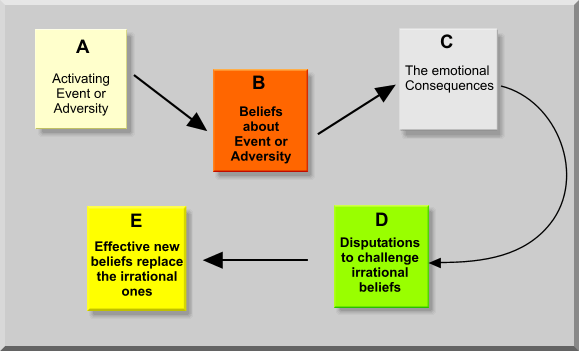
Moreover, sometimes these irrational beliefs affect our behaviour too. The effect of our cognition on our behaviour and how to tackle the same is represented by Ellis’s ABCDE model where “A” is the Activating or triggering event. “B” refers to our irrational Belief about the event at “A.” That belief then leads to “C,” the emotional and behavioral Consequences. “D” stands for Dispute or arguments against irrational beliefs. “E” stands for new Effective or rational emotions and behaviors that result from more reasonable thinking about the original event. This is an effective method to challenge ones irrational thoughts and beliefs.

Situations, events, feelings are not good or bad, it’s our perception and inferences which make them so. As I mentioned before, nothing good comes easy, you’ll have to make an obvious effort to achieve it. There is no absolute reality. Its not possible to achieve everything we want. We try, we fail, we try again ... this is how life goes. We all are fallible human beings. Ask yourself the Socratic question “So what?” So what, If your boss was rude to you? So what, if you failed in your exam? So what, if your friends think you are fat? It cannot change who you really are. Strive for excellence not perfection. Start valuing yourself. You are far more resilient than you think you are!!!!